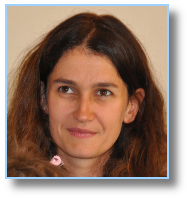

Florence Bertails-Descoubes


INRIA Researcher in BiPop team, INRIA Rhône-Alpes / LJK

mail INRIA Rhône-Alpes
655 avenue de l'Europe
38 334 Saint Ismier Cedex, France
office   E216
email florence (dot) descoubes (at) inrialpes (dot) fr


What's new

Propositions of research master projects for 2009-2010 are starting to come up.


Research Interests

In Fall 2007, I have joined BiPop team as a 'Chargée de Recherche' at INRIA in Grenoble, France. My research interests deal with the modeling and the simulation of complex mechanical objects, mainly for graphics applications. In particular, I am interested in the following topics: modeling of nonlinear thin structures (such as fibers or cloth), simulation of contact and friction, interactions between fluids and solids, modeling of heterogeneous materials (such as hair or granulars), adaptive animation, and control of physics-based simulators.
In 2006 - 2007, I did a post-doc at the IMAGER Lab of the University of British Columbia, in beautiful Vancouver, where I have been working with Robert Bridson and Christopher Batty on physically-based models for coupling fluid and solid structures. During my Ph.D. in EVASION team, I have been working on hair simulation under the supervision of Marie-Paule Cani and Basile Audoly. Click here to access my Ph.D. web page.


Selected Publications

The full list of my publications is given here. Below is a list of selected publications.

International Journals

Linear Time Super-Helices
Florence Bertails. Eurographics 2009.
[Project website] [PDF] [Movie]
Summary: Thin elastic rods such as cables, phone coils, tree branches, or hair, are common objects in the real world but computing their dynamics accurately remains challenging. The recent Super-Helix model, based on the discrete equations of Kirchhoff for a piecewise helical rod, is one of the most promising models for simulating non-stretchable rods that can bend and twist. However, this model suffers from a quadratic complexity in the number of discrete elements, which, in the context of interactive applications, makes it limited to a few number of degrees of freedom - or equivalently to a low number of variations in curvature along the mean curve. This paper proposes a new, recursive scheme for the dynamics of a Super-Helix, inspired by the popular algorithm of Featherstone for serial multibody chains. Similarly to Featherstone's algorithm, we exploit the recursive kinematics of a Super-Helix to propagate elements inertias from the free end to the clamped end of the rod, while the dynamics is solved within a second pass traversing the rod in the reverse way. Besides the gain in linear complexity, which allows us to simulate a rod of complex shape much faster than the original approach, our algorithm makes it straightforward to simulate tree-like structures of Super-Helices, which turns out to be particularly useful for animating trees and plants realistically, under large displacements.
A Fast Variational Framework for Accurate Solid-Fluid Coupling
Christopher Batty, Florence Bertails, & Robert Bridson. ACM SIGGRAPH 2007.
[Project website] [PDF] [Movie]
Summary: Physical simulation has emerged as a compelling animation technique, yet current approaches to coupling simulations of fluids and solids with irregular boundary geometry are inefficient or cannot handle some relevant scenarios robustly. We propose a new variational approach which allows robust and accurate solution on relatively coarse Cartesian grids, allowing possibly orders of magnitude faster simulation. By rephrasing the classical pressure projection step as a kinetic energy minimization, broadly similar to modern approaches to rigid body contact, we permit a robust coupling between fluid and arbitrary solid simulations that always gives a well-posed symmetric positive semi-definite linear system. We provide several examples of efficient fluid-solid interaction and rigid body coupling with sub-grid cell flow. In addition, we extend the framework with a new boundary condition for free-surface flow, allowing fluid to separate naturally from solids.
Super-Helices for Predicting the Dynamics of Natural Hair
Florence Bertails, Basile Audoly, Marie-Paule Cani, Bernard Querleux, Frédéric Leroy, & Jean-Luc Lévêque. ACM SIGGRAPH 2006.
[Project website] [PDF] [Movie]
Summary: Simulating human hair is recognized as one of the most difficult tasks in computer animation. In this paper, we show that the Kirchhoff equations for dynamic, inextensible elastic rods can be used for accurately predicting hair motion. These equations fully account for the nonlinear behavior of hair strands with respect to bending and twisting. We introduce a novel deformable model for solving them: each strand is represented by a Super-Helix, i.e., a piecewise helical rod which is animated using the principles of Lagrangian mechanics. This results in a realistic and stable simulation, allowing large time steps. Our second contribution is an in-depth validation of the Super-Helix model, carried out through a series of experiments based on the comparison of real and simulated hair motions. We show that our model efficiently handles a wide range of hair types with a high level of realism.

SIGGRAPH Courses/Classes

Class on Realistic Hair Simulation: Animation and Rendering, ACM SIGGRAPH 2008
Organizer: Florence Bertails
Lecturers: Florence Bertails, Sunil Hadap, Marie-Paule Cani, Ming Lin, Steve Marschner, Tae-Yong Kim, Zoran Kacic-Alesic, & Kelly Ward.
[Project website]
Summary: The last five years have seen a profusion of innovative solutions to one of the most challenging tasks in character synthesis: hair simulation. This class covers both recent and novel research ideas in hair animation and rendering, and presents time tested industrial practices that resulted in spectacular imagery.
A Course on Strands and Hair, ACM SIGGRAPH 2007
Organizer: Sunil Hadap
Lecturers: Sunil Hadap, Marie-Paule Cani, Ming Lin, Florence Bertails, Kelly Ward, Steve Marschner, Tae-Yong Kim, & Zoran Kacic-Alesic.
[ Project website ]
Summary: Over the past six years, there has been a Renaissance in hair modeling, rendering, and animation. This course covers the gamut of hair simulation problems and presents working solutions. Topics include recent and novel research ideas, and time-tested industrial practices that created spectacular imagery.

French Articles

Simulation Numérique des Mouvements de Chevelure
Florence Bertails, Basile Audoly , & Marie-Paule Cani. Interstices, October 2007.
[HTML paper] (in French)
Summary (French): Synthétiser le mouvement d'une chevelure suscite un intérêt croissant de la part des développeurs de jeux vidéos ou de films d'animation mais aussi des industriels en cosmétique. Des simulations très réalistes ont pu être réalisées grâce à un travail scientifique basé sur un nouveau modèle mécanique du cheveu sous forme d'hélices par morceaux.

Note: A short version of this article has been published in the French journal La Recherche in December 2007. More details here .

Teaching

During my Ph.D., I have been working at Département Télécom and ENSIMAG as a teaching assistant (CIES). I have participated to the teaching of the following topics and projects: Probability and Statistics, Theory of Codes and Algorithmic, Applied Analysis, and Assembler Project in C.
In 2009 I have participated to the teaching of the Mobinet classes.
In 2009-2010 I'm involved in the teaching of Optimization at ENSIMAG.
I will participate to the Spring School on Nonsmooth Mechanics organized by BiPop in June 2010.


Students

Available 2010 internships.
Feel free to contact me if you are interested by one of the available research topics, or by any other project related to physics-based simulation.


Collaborations


Links